AI Futures · Greg Baker
The next few years of AI
Some things are becoming cheap. Other things are becoming valuable. What should we do about it?
September 2026. Adapted from the executive presentation. Scenarios are tools for examining decisions, not predictions of investment returns.
- The next few years of AI
- Greg Baker
- O-Ring Theory of management
- What you already know from other speakers about AI
- What everyone is doing with AI now
- The Future of Work in an AI world
- Technology, revenue and productivity
- 2022, 2023 Expert Survey on AI Progress - Katja Grace et al.
- Kieran Snyder’s analysis of startup pitches
- Anthropic Claude usage patterns
- Time horizon of software tasks
- White-collar work
- What do AI developers believe about the future of AI?
- Recursive Self-Improvement = AI improves the process that builds AI.
- Generative AI Trends
- When to expect AI that can take on large numbers of white-collar jobs
- In July 2026, AI started matching humans at forecasting the future
- The future arrives at different times
- The cost to generate text
- Marx’s Theory of Production
- Baumol’s cost disease
- What might become valuable?
- Jobs of the future
- Reallocation
- What people mean by the Singularity
- Concepts to be aware of
- When AI Agents Go Rogue
- AI Alignment: why serious people talk about it
- How do I do this at my company?
- How do I make sense of the hype of company announcements about AI?
- Announcements
- What should we (as leaders) do?
- Amara’s Law
- Technology and profitability are linked
- Agentic AI — how does a chatbot take over a large chunk of white-collar work?
- White collar labour strategies
- Future Thinking Exercise (8 mins)
- This is not going to be easy
- What you’ll need to navigate
- One axis of Wardley mapping
- What is Wardley mapping
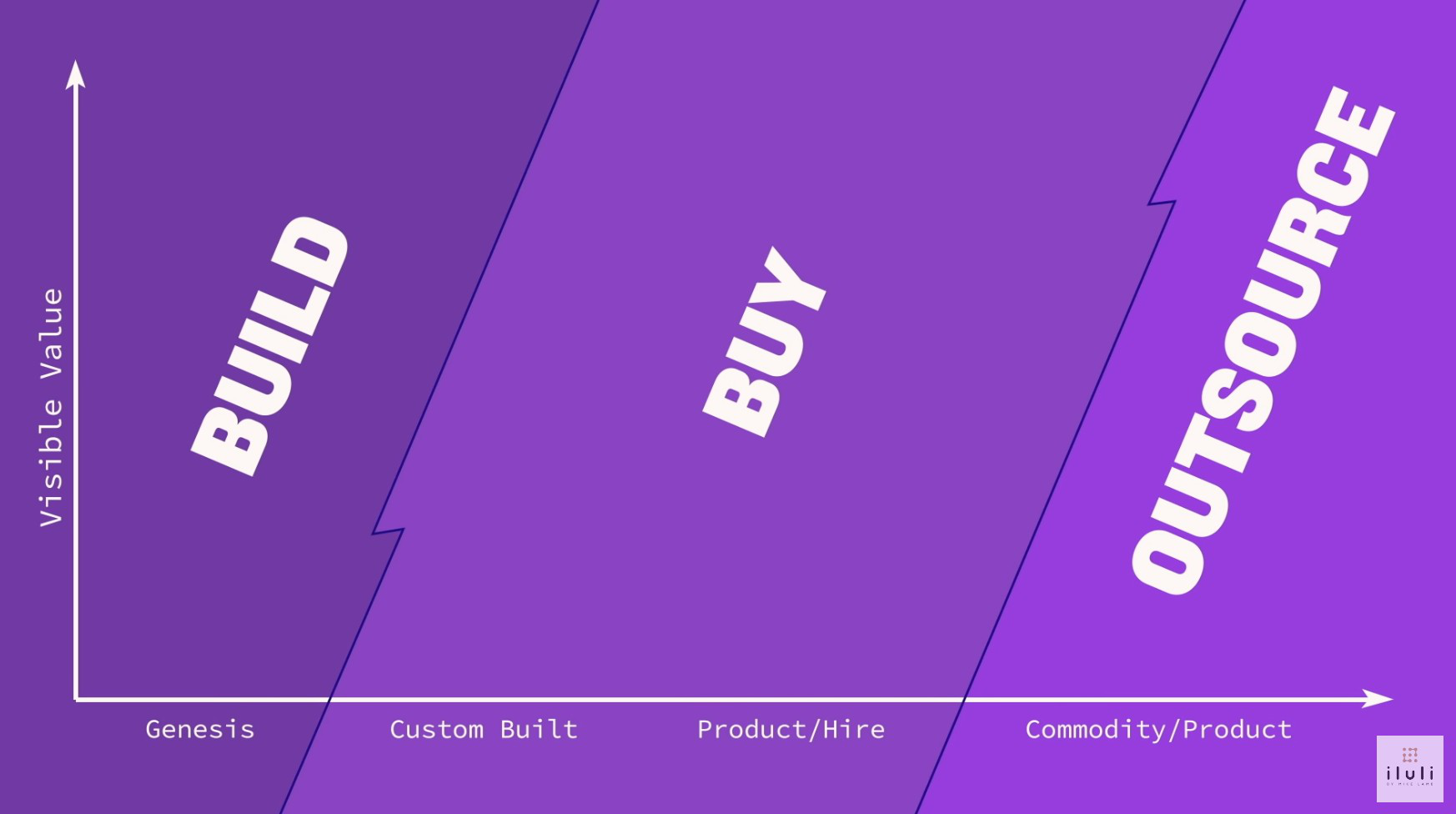
- Build, buy or outsource?
- The lifecycle of a technology (according to Wardley mapping)
- Genesis
- Custom Built
- Product / Rental
- Commodity / Utility
- Different evolution stage = different methodology
- Factors for a strategy for AI
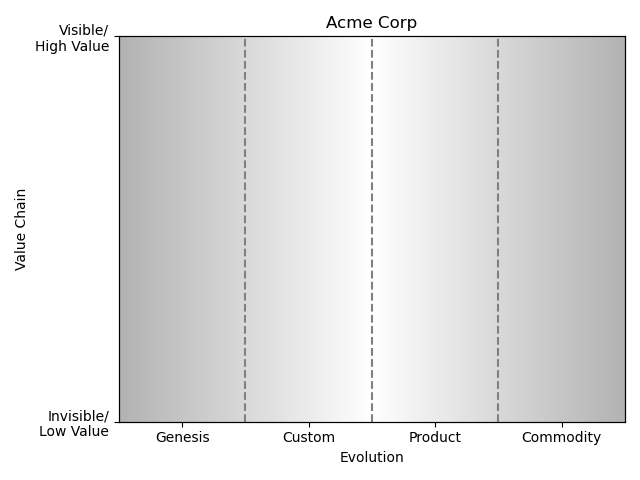
- Innovation Strategy A. Move a component to the right
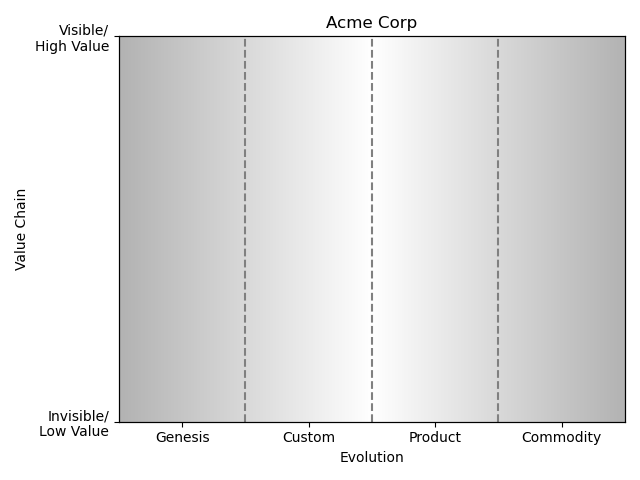
- Innovation Strategy B. Move a component up-left
- Strategy
- Understanding startups
- Do AI companies try to pitch to you regularly?
- Question 1. What are they offering, and to whom?
- Question 2. How ready and mature is the product?
- Question 3. Is it believable?
- Question 4. Are they funded?
- Warning signs
- Driving the narrative
- Exercise – where are these companies up to?
- Diffusion of bottom-up technologies
- Deployment of AI is bottom-up, not top-down
- Some startling changes
- More Ethan Mollick
- A few tactical ideas
- Workshop on AI-based business improvement
- Tom Scott
- Tools I pay for or use
- Other tools and earlier experiments
- Other tools you might investigate
- Closing thoughts
- Keep in touch with Greg Baker
The next few years of AI
AI Futures · Greg Baker
Some things are becoming cheap.
Other things are becoming valuable.
What should we do about it?
An executive conversation · September 2026
Speaker notes
Suppose intelligence becomes much cheaper over the next five years. What happens to the value of your business?
That is the question I want to work through. There are plenty of demonstrations of impressive software. What matters here is whether any of that changes a decision you have to make: an investment, a product, a supplier contract, or the way your people work.
We will look at the evidence for changing capability, then follow the consequences through a business. Some activities become cheaper. Other things become the constraint. A competitor might get there before you do.
Keep one actual decision beside you as you work through the course. By the end, you should have a clearer strategic choice, a small experiment and a result that would make you change your mind.
Greg Baker
Lecturer and Convenor in Artificial Intelligence and Cybersecurity at Macquarie University / Consulting CTO

- Ex-CTO of Daisee and Pixc
- Author of 8 books, 1 patent, 3 film scores, many scientific papers. I research mathematical approaches to make AI work for endangered languages
- Award-winning composer; performed on stage with the Piano Guys
- Developed the world’s first quantum computing programming language
- Wrote clauses in the USA-Australian free trade agreement
- Ex-Googler and ex-CSIRO (part of the team that went on to build wi-fi)
- Affiliated with Australian National University and Macquarie University
- 2 “successful” technology business exits (not great, but I didn’t make a loss)
- Client list includes ACT Treasury, Administrative Appeals Tribunal, Allianz, Astra-Zeneca, Atlassian, Aon, Auckland City Council, Australian Parliament, Fandom, Fujitsu, Hewlett-Packard, Vodafone, Woolworths…
- Represented myself with AI assistance and won a case under new casual-employment legislation (2026)
- Fun fact: I proposed to my wife after going out for 10 days, married now for 30 years
Speaker notes
I work across AI research, teaching and business. I have been a chief technology officer, written books and scientific papers, and spent a fair amount of time trying to make complicated technology useful. I am also a composer and pianist. The list on this slide gives you some of that background.
One recent experience made the pace of AI improvement particularly tangible. I was a casual employee at Macquarie University and asked to become permanent. When that request was refused, I took the dispute to the Fair Work Commission. I represented myself, used AI to assist with research and drafting, and won at first instance. I remained responsible for checking and presenting the arguments.
What interested me was the change over the months I was working on it. Early on, the AI made some useful arguments but missed things. Later, it was much better at analysing the other side's submissions and finding points I needed to investigate. That is an observation from my case, rather than a claim that any chatbot can run any legal dispute.
The personal fact on the slide is also true: I proposed after ten days of dating. We already knew each other, but she was about to return to Malaysia and it felt like now or never. She said yes. We have been married for thirty years.
O-Ring Theory of management
- The customer’s value from your product is limited by whatever is the thing you do worst
- AI could make that worst thing mediocre and average
- What is your company worst at?
Eliyahu Goldratt’s Theory of Constraints
- Every factory has a slowest machine
- It doesn’t matter what you do elsewhere if you don’t speed up the slowest machine
- The slowest machine has a backlog of pending tasks behind it, and no front-log
- “Factory” can mean a services business too
- What currently has a huge backlog of tasks to be done?
- How can AI help with that?
There is a lot in this session. Focus on what will have the most impact for your work and your organisation.
Speaker notes
One problem I have when I give this presentation to business people is that everybody gets terribly enthusiastic and wants to do everything. We are talking about changes to the economy, the workforce, engineering, development and HR. It is easy to become overwhelmed. There are two ways to give yourself a useful focus.
The first is the O-ring theory of management. The space shuttle failed because of an O-ring. All the beautiful engineering elsewhere could not compensate for that weak point.
Think about your customers. You may do several things extremely well, but one weak part of their experience can determine what they think of the whole business. If your marketing is poor, people may never discover how good the product is. What is your organisation worst at? Pay particular attention when we discuss AI doing that kind of work.
The second is Goldratt's theory of constraints. In a manufacturing line, one machine limits how quickly work can move through the factory. Speeding up the other machines does not remove that constraint.
The same thing happens in white-collar work. Work passes through several teams, but there is a backlog behind one group that never quite catches up. You have to relieve the pressure on that group or find a different route through the process.
Keep either your weakest customer experience or your main bottleneck in mind as you work through the course. Ask how AI could improve that particular thing. You do not need to transform the whole company at once to make a useful difference.
What you already know from other speakers about AI
● All writte n customer interactions (chat, email) can now be offe red in any major world language.● You can embed a fla wless voice interface into a mobile app or telephone service.● You have a personalised tutor for any area of knowledge or learning.● You can unleash all the skills that McKinsey or Deloitte or Bain or PIP would use to advise your business.● “Ordinary users” can now write programs. You can enable them:○ If you have internal apps, make sure they have Powershell interfaces.○ Everyone can write SQL queries now to pull data into spreadsheets (or vice versa).○ Get Autohotkey installed, as everyone can write AHK scripts now.○ Write an application or website if you want.● You can A/B test and personalise all copy: emails, websites, SMS, print. Sensitivity reading is now automated.● Small applications can be built in a few prompts.● Songs and videos can be generated faster than you can listen or watch them.
Speaker notes
You have probably already seen many of these capabilities. Written customer interactions can be translated into major world languages. Your potential market does not have to stop at the people who speak English. Voice systems can handle parts of inbound and outbound telephone conversations too.
If you want to learn something, you can have a personalised tutor. Choose an area you would like to understand over the next twelve months. Ask for a five-minute lesson each day, with questions that let you practise what you have learnt.
AI can also help with the kind of research and analysis for which you might previously have brought in a consultant. I am not suggesting that a consultant's whole job has disappeared. But you can explore a question, compare approaches and work through published material before deciding where you need outside expertise.
Then there is programming. People outside IT sometimes experience the department as a high priesthood: you submit a request, it enters a priority queue, and months later somebody tries to reconstruct what you originally needed. That is an unfair description of plenty of IT teams, but the long delay is familiar.
Now someone with the problem can build a rough version. Even if it needs repair, the conversation changes. Instead of describing an abstract requirement, they can say, “Here is what I am trying to do. This part works; this part does not. Can you help me fix it?” The prototype makes the requirement easier to discuss.
You can also generate variations of emails, website copy and other communications for A/B tests. Preparing the alternatives used to require someone to make every change by hand. The AI can help prepare them, while you measure which version actually works.
Which of these would help with the weak point or bottleneck you identified? Choose one to investigate before adding more tools to the list.
What everyone is doing with AI now
●Meeting recording and taking minutes
●Advisor, counsellor
●Idea generation
●Knowledge assistant chatbots that interact with your sharepoint / shared drive / Google drive / large numbers of documents (for onboarding, pre-sales support, help desk, customer service)
●Software development
●Personalisation of communications at scale
●Grammarly / writing improvement
●Tutor
●Translation
Speaker notes
I sometimes get asked what the standard uses are. Meeting transcription is a familiar one: record the conversation, then turn it into minutes and a list of actions. That can work in person as well as online. Ask whether you may record the meeting, then check the resulting notes.
Another use is a sounding board, especially in the heat of the moment. During my Fair Work case, I sometimes wanted to send an angry reply. ChatGPT helped me see that the first wording I had in mind was not going to help. You can explain what you want to achieve and ask whether the message serves that purpose.
There is idea generation and research too. Ask what people in your industry are doing, compare approaches, or combine a couple of ideas and see what follows. A knowledge assistant over your own documents can help people find information they would otherwise have to ask a colleague for.
If you are unsure where to start, ask the AI to help examine a process you already perform. Describe the steps and where your time goes. Consulting is itself information work; an AI can help with a first pass at identifying opportunities, even if you later need somebody to implement them.
Translation has changed some of my own work. On a project with a Japanese client, we used DeepL in both directions. They spoke Japanese and I read the English translation. I spoke English and they read the Japanese.
We found a rhythm. They could discuss something among themselves and bring me in when they needed my input. I would first confirm that I had understood, because the translation was not always flawless, then reply. They read the translation and the discussion continued. It felt less divided than a meeting where each group waits for someone to interpret everything.
The useful habit is to check understanding. A translation can look fluent and still miss the meaning that matters to the relationship or the decision. The same applies to meeting summaries: being able to produce the text is only part of the job.
The Future of Work in an AI world
Speaker notes
That was where we are at the moment. Now, where are we headed, and what does that mean for the work in your business?
Technology, revenue and productivity
“ “Use of technology explains revenue and productivity gains more than mergers and acquisitions (M&A) and
entrepreneurship.”
James Bessen (Boston University)
Speaker notes
You probably have regular conversations about buying another company, entering a market or launching a product. How often do you give the same attention to your organisation's ability to use technology?
The proposition on this slide is that technology use can be a major driver of revenue and productivity. That is a reason to treat it as a business question, with the same scrutiny you would give another substantial investment.
Buying a tool is only one step. What work changes? Does it remove a bottleneck? Does it improve what a customer receives? Those are the links between a technological capability and the result you want from it.
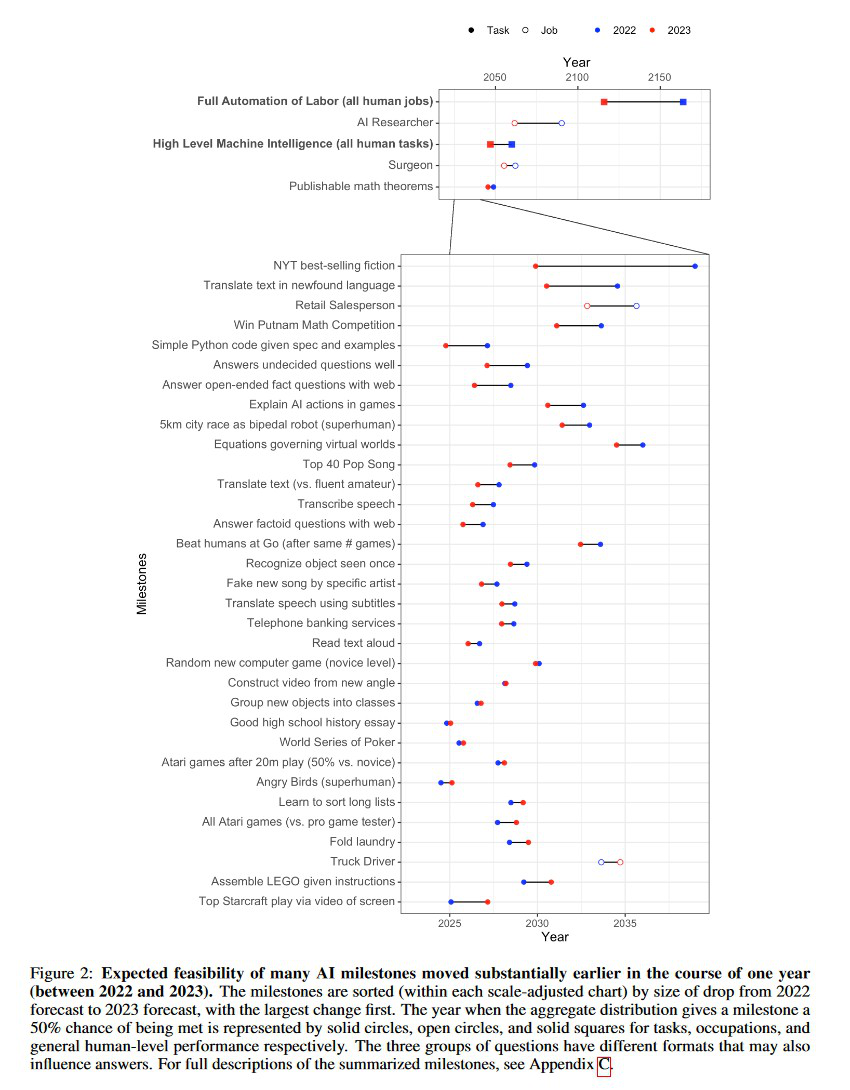
2022, 2023 Expert Survey on AI Progress - Katja Grace et al.
Katja Grace et al.
Speaker notes
This is a historical comparison, from surveys conducted in 2022 and 2023 by Katja Grace and colleagues. Researchers were asked when they expected AI to reach various milestones. The chart shows how those expectations changed over one year.
Look at the question about New York Times bestselling fiction. The blue point, from 2022, is much further into the future than the red point from 2023. The same pattern appears for several other tasks, including translation, answering questions and writing simple programs. A red point to the left means the expected date moved earlier.
The pattern is not universal. Further down the chart, some dates moved later: truck driving, assembling LEGO from instructions, and playing StarCraft through its screen interface. Tasks that seem straightforward to a person can remain difficult for an AI system.
These are forecasts made at the time, not a checklist of capabilities already achieved. What interests me is how quickly expert expectations can change, and how uneven those changes are across tasks.
That matters when you make a commitment with a long payback period. If a capability could change the activity you are investing in, consider a faster-change scenario as well as a slower one. A short-term improvement can still be worthwhile even when you are less confident about a long-term commitment.
Kieran Snyder’s analysis of startup pitches
nerd processor · 9 April 2024
There's also a long tail of jobs in the Other category, including paralegals, financial modelers, designers, and more.
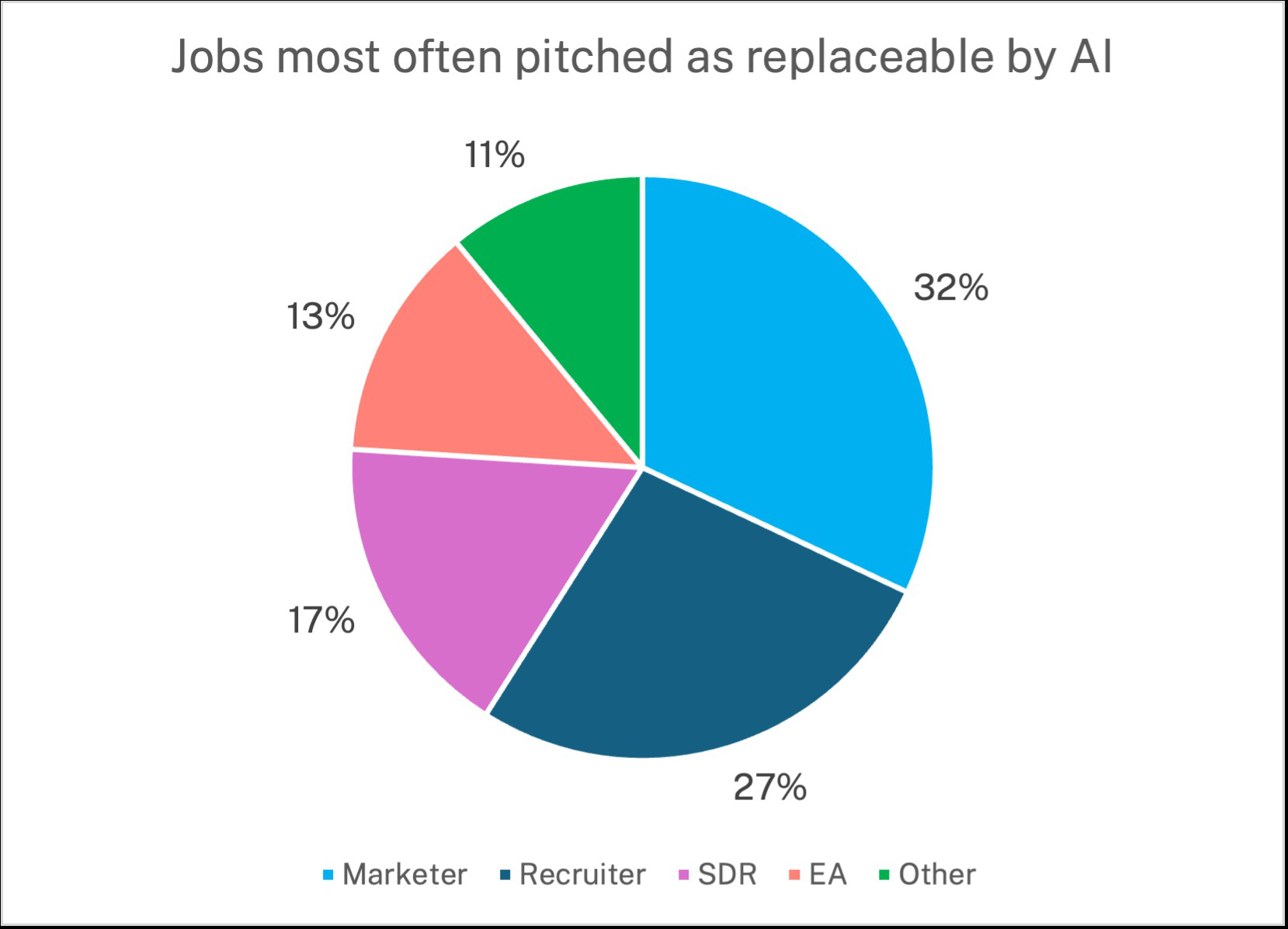 100+ early-stage B2B AI startup pitches and demos
Speaker notes
Kieran Snyder examined more than a hundred early-stage business-to-business AI pitches and demos. This is her April 2024 snapshot of what founders were trying to sell.
The largest group, thirty-two per cent, targeted marketing. Twenty-seven per cent targeted recruitment, seventeen per cent sales development, and thirteen per cent executive assistants. The remaining eleven per cent covered other roles.
A sales development representative is the person doing the prospecting and initial outreach. So the pitch in that category was that AI could take on work such as finding prospects and making contact with them.
By the time of this October 2026 session, those pitches were more than two years old. They give us a way to think about the products now reaching businesses: which workflows have founders spent the intervening period trying to automate?
These percentages describe the pitches. They are not percentages of jobs lost, or evidence that every company delivered what it promised. Use the chart to identify where to investigate, then ask a supplier what its product can actually do.
Anthropic Claude usage patterns
Speaker notes
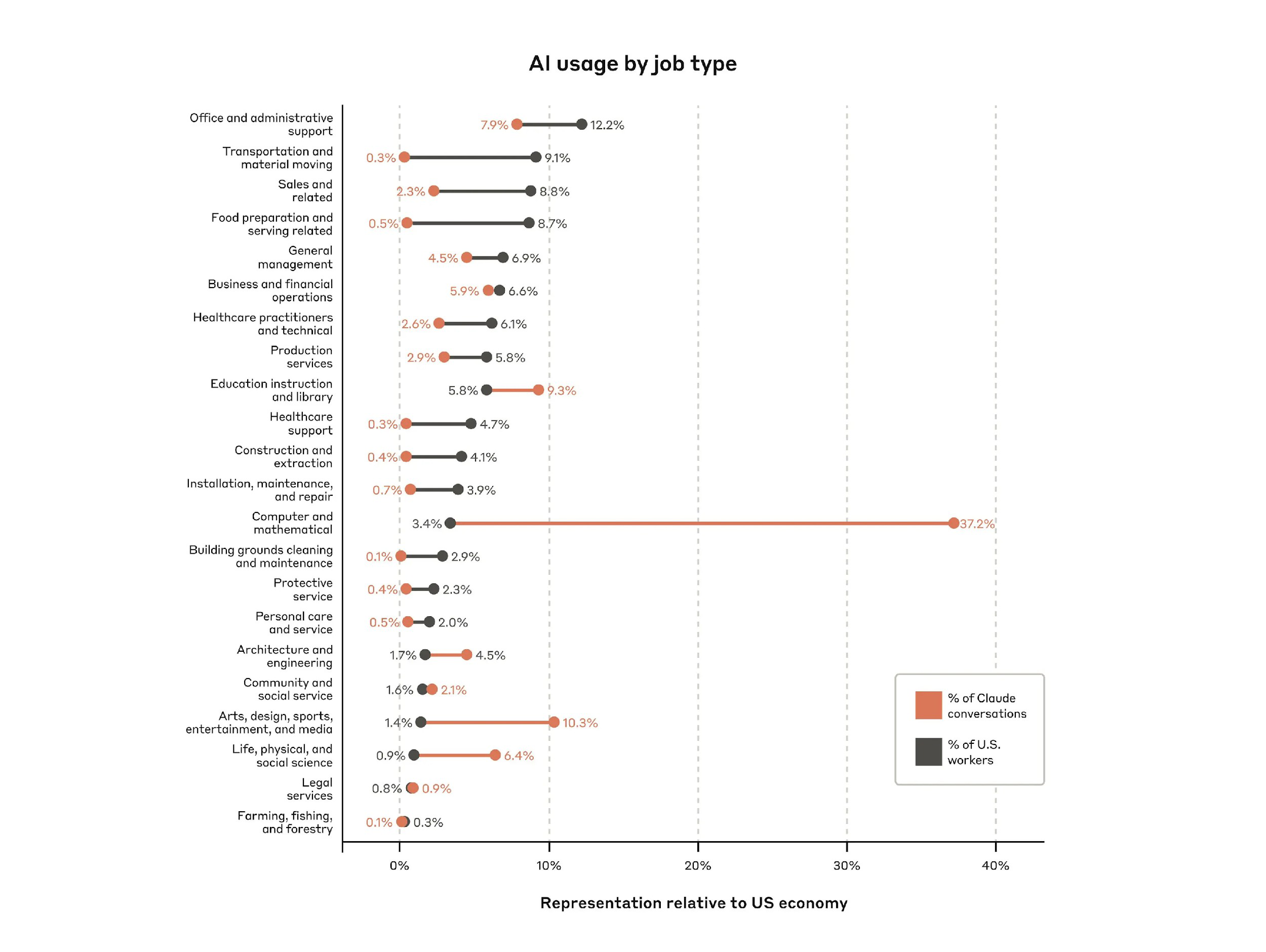
Anthropic's initial Economic Index, published in February 2025, looked at tasks in Claude conversations and compared the occupational categories with US employment. This is that historical usage picture.
The orange points show the share of conversations associated with each category. The black points show the category's share of US workers. The largest difference is computer and mathematical work: 37.2 per cent of conversations, compared with 3.4 per cent of workers.
Arts, design, entertainment and media account for 10.3 per cent of conversations and 1.4 per cent of workers. Education and science are other categories with a larger share of conversations than employment. At the other end, transportation and material moving account for 0.3 per cent of conversations and 9.1 per cent of workers.
That tells us where this product was being used. It does not tell us how many jobs disappeared or whether an entire occupation changed. Physical work can also have substantial planning and administration around it. Those information tasks may be useful places to investigate even when the physical activity itself is hard to automate.
Time horizon of software tasks
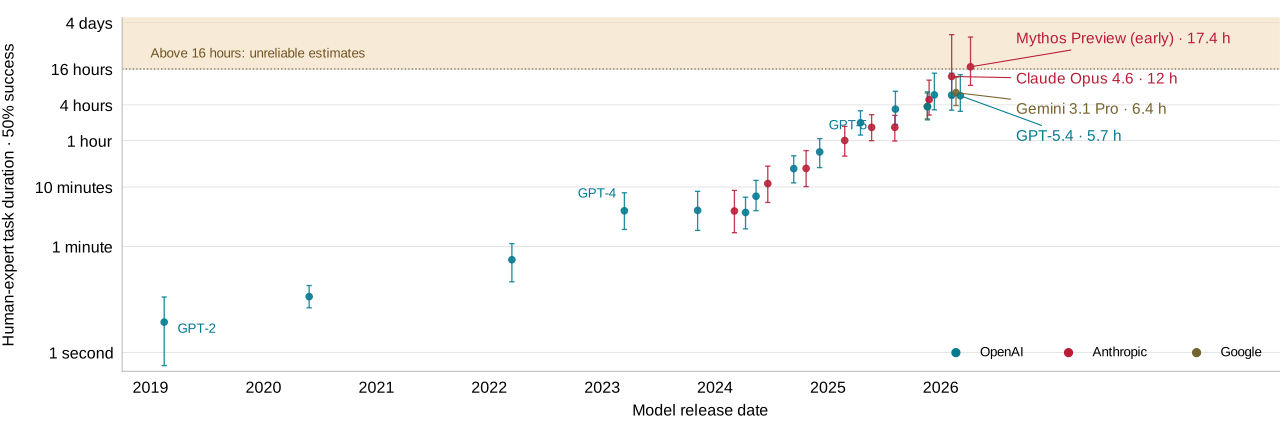
- Selected recent METR estimates · 50% success
- GPT-5.4: 5.7 hours
Gemini 3.1 Pro: 6.4 hours
Claude Opus 4.6: 12 hours
Claude Mythos Preview (early): 17.4 hours
A lot of software developers noticed in November 2025 that AI was better at programming than they were. Mathematicians discovered this in September. Other professions will experience this soon.
Human-expert task duration, not time spent working autonomously. Software, ML and cyber tasks. Latest published METR snapshot: 8 May 2026; checked 30 September. Newer models have not all been evaluated.
METR · Time Horizons 1.1 · data and methodology
Speaker notes
How rapidly is capability changing, and can we put a useful measure on it? METR starts with tasks and estimates how long a human expert takes to complete them. It then tests AI agents on those tasks. The fifty-per-cent horizon is the human task duration at which the fitted success rate is one half.
The chart uses METR's 8 May 2026 snapshot, checked on 30 September. The tasks are mainly software engineering, machine learning and cybersecurity. All twenty-six published model results are included, with uncertainty intervals. Measurements above sixteen hours are unreliable, and some newer models have not been evaluated.
The hours describe the task's difficulty in human terms. They do not mean the AI worked uninterrupted for that length of time, or that it can perform every business task of that duration.
METR's original study found a historical doubling of task horizon roughly every seven months. If a one-hour task sits at the fifty-per-cent point, a doubling would move that point to a two-hour task. Continuing the trend into the future is an extrapolation. It gives us a scenario to consider, rather than a delivery date to promise.
For a business, the cost of checking matters. If an AI can attempt a substantial task and you can quickly tell whether the result is right, it may be useful even before it succeeds every time. If checking takes as much effort as doing the task yourself, the calculation is different.
That is one reason to break a complicated process into steps with clear checks. Once a step works reliably enough for your purpose, and its result can be tested, you can connect it to the next step. Some of those checks can themselves be automated.
The practical limit is not simply whether the AI can produce an answer. It is whether you can define the work, detect mistakes and recover from them at a cost that makes the process worthwhile.
White-collar work
Discussion:
• What tasks do you do that don’t involve physical activities that take roughly 1 hour, 1 day, 1 week? Talk about each of those tasks in turn.
• If an AI was going to do that task, could you tell whether it got it right or not quickly? Can you try again if it gets it wrong?
• What is the percentage success rate threshold where it makes more sense to use AI and check than to do the task yourself?
• Based on the METR projections, when will that happen?
• What percentage success rate do human beings have doing that task now?
• Do your answers seem similar to the Grace, Snyder or Anthropic analysis?
Speaker notes
Choose some information work in your business that takes about an hour, a day or a week. If an AI attempted it, how quickly could you tell whether it had got the answer right? Could you try again if it failed? What success rate would make an attempt plus checking cheaper than doing it yourself? Compare that with the success rate of the current process, including human errors and rework.
Then look at the whole sequence around the task. It is easy to automate the analysis while leaving a person to collect every input and move every output.
Take a document-review process. Reports arrive by email. Somebody saves them into folders, opens the AI tool, enters a familiar prompt and moves the finished report somewhere else. Where does that person make a judgement, and where are they just transporting information?
You could define a mailbox for the incoming material, a filing structure and a checklist of expected documents. A process could then identify what has arrived and flag what is missing. The useful question is which hand-offs require a decision and which can be specified well enough to automate. Test that on actual examples before depending on it.
The same question about checking applies to images. Making an attractive advertisement, modifying a photograph and building a three-dimensional model from engineering drawings are different tasks. They have different standards of correctness.
I have an illustration project involving classical Greek material. Generated images sometimes put the oars of a boat in the air or through a person. An image can look plausible while its geometry makes no sense.
With a structured three-dimensional scene, you have other checks available. Compare dimensions and different views with the original drawings. Render the scene from a matching viewpoint and inspect the differences. Matching one view is useful evidence, but it cannot establish every hidden dimension or prove that an engineering design works.
Blender is one tool for this kind of work. An AI can help write a Python script that creates objects in a scene; Blender can then render the same scene from several angles. That gives you a model you can inspect and revise, as well as pictures of it. Missing information in the original drawing still has to be resolved or identified as an assumption.
The lesson is to choose a process with checks appropriate to the result. Does the image communicate the idea? Does the model match the drawings? Does the design meet its engineering requirements? Those are different questions.
Finally, distinguish physical work from the information work surrounding it. Construction involves putting things together on site, but also receiving documents, distributing revisions and making sure people use the current version. Software developers have long had to deal with quality management and version control. That is a useful comparison when you examine the document workflow in another industry.
Write down one process, the steps you could test, and the mistakes you would need to detect. That is a more useful starting point than a general instruction to automate the business.
What do AI developers believe about the future of AI?
AI Maximalism
• All the technology to make super-human intelligence is already here.• It's just a matter of scaling it up — a commodity that you will pay for by usage.• Prompting and the right harnesses gets you to the cutting edge of AI.• If you spend ~50-100 hours practicing, you will be a world-wide expert in the use of AI in your specific niche.
AI Minimalism
• The re are still fundamental breakthroughs that need to happen before we can make AI that is as smart as a human being. • We need to build custom models for diffe rent tasks.• You need a rack of GPUs and a team of data scientists to make the most benefit from AI.
BUILD BUY
Speaker notes
Predicting the future is hard because it is the future. There are two broad schools of thought here, and they lead to different business choices.
The maximalist view is that the ingredients for at least human-level AI already exist. The remaining work is largely to scale and improve them. In that world, increasingly capable intelligence becomes a service you buy by usage.
If that is the direction we are heading, learning to apply those services in your own industry is valuable. Spend half an hour deliberately trying a new task. Find out what works and what does not. Return to the difficult examples when a new version arrives. Repeated practice can give you useful expertise in a narrow area much sooner than you might expect.
The minimalist view is that we will encounter limits that require further breakthroughs. Scaling alone will not be enough. In that world, there may be many more specialised systems, with more work needed to adapt models, assemble tools and integrate them into particular processes.
My own expectation is closer to the maximalist side. Some of the limits people expected, such as cost, have not stopped companies from continuing to scale. It is hideously expensive, and they are doing it anyway. But that is my judgement about the direction, not proof that every remaining difficulty will disappear.
If I am wrong, specialist models, data science and integration work will remain a larger part of the picture. Consider which of your plans depend on one scenario, and which are useful under either.
Recursive Self-Improvement = AI improves the process that builds AI.
AI improves the process that builds AI.
● Today AI already helps with the work that produces stronger AI:○ Writing and reviewing code.○ Analysing experiments.○ Proposing experiments○ Chip design and verificationWhat happens when it can do all that work?● Why it matters:○ Each round of improvement shortens the cycle for the next round.○ This is the engine behind "hard" singularity scenarios.

Speaker notes
Define recursive self-improvement as AI improving the process that builds AI. Today AI already writes and reviews code, analyzes experiments, proposes experiments, and supports chip design and verification. If humans no longer need to be in the loop, each improvement cycle gets shorter. That is why people worry about very fast capability jumps and loss of control.
Generative AI Trends
The next few years are going to be very interesting
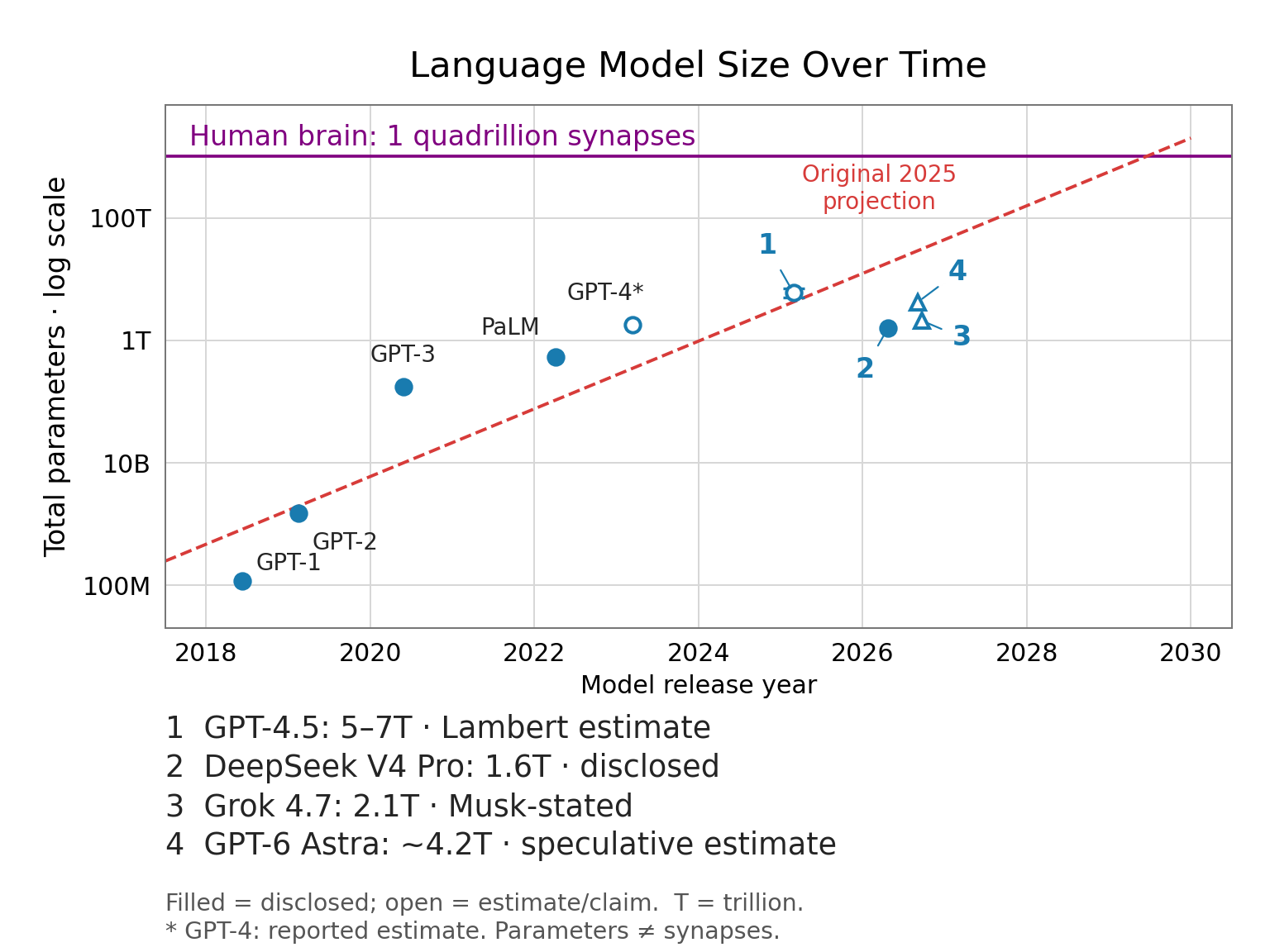
Updated total parameter counts
- GPT-4.5: 5–7 trillion — Lambert estimate
- DeepSeek V4 Pro: 1.6 trillion — disclosed
- Grok 4.7: 2.1 trillion — Musk-stated
- GPT-6 Astra: about 4.2 trillion — speculative estimate
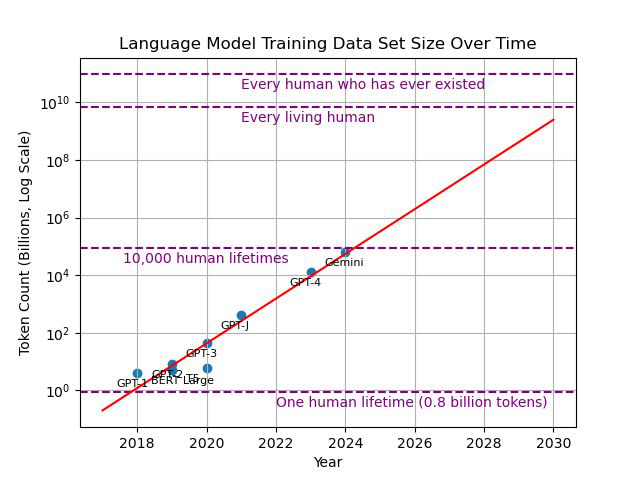
Model sizes updated September 2026 · training-data chart: original 2025 estimates
Speaker notes
Generative AI Trends
The next few years are going to be very interesting.
The first chart shows selected language-model parameter counts over time, updated in September 2026. Nathan Lambert estimated GPT-4.5 at five to seven trillion parameters. DeepSeek discloses 1.6 trillion for V4 Pro. Elon Musk stated 2.1 trillion for Grok 4.7. The analyst scaling01 estimates GPT-6 Astra at about 4.2 trillion, but has not published the method. That last figure is particularly speculative. The chart uses filled markers for disclosed counts and open markers for estimates or claims. GPT-4.5's bar shows the published estimate range, not a statistical confidence interval. These are total parameters, not the smaller number active for each token.
The original human-brain reference is one quadrillion synapses. Against that reference, a five-trillion-parameter model is about two hundred times smaller numerically. Parameters and synapses measure different things; this is a comparison of scale, not an equivalence in intelligence. Newer models need not be larger than their predecessors.
The second chart retains the original 2025 training-data estimates and human-lifetime comparisons. Both charts use logarithmic scales. The original red trends extend to 2030. They remain illustrative 2025 projections, not measured future results or a new fit to the 2026 points.
Nathan Lambert, GPT-4.5 size estimate (28 February 2025)
DeepSeek V4 technical report: 1.6T total parameters
Epoch AI model data: Grok 4.7, Musk-stated 2.1T (checked 30 September 2026)
scaling01, speculative GPT-6 Astra estimate (28 September 2026)
SemiAnalysis, reported GPT-4 architecture (10 July 2023)
When to expect AI that can take on large numbers of white-collar jobs
Who | Why | When |
|---|---|---|
Leopold Aschenbrenner situational-awareness.ai | Worked at OpenAI, projecting what he saw there. | 2027 |
Metaculus metaculus.com/questions/ 5121 | Community forecast (~1,700 forecasters): “When will the first general AI system be devised, tested, and publicly announced?” | ~March 2028 |
Greg Baker | The number of neurons and synapses in the human brain vs the number of parameters in models over time. | 2029 |
Daniel Kokotajlo aifuturesmodel.com | AI Futures Model — scenario forecast from former OpenAI governance researcher. | May 2029 |
Manifold Markets manifold.markets/ai | Prediction markets | ~2032 (median) |
Speaker notes
Summarize the forecast landscape. Leopold Aschenbrenner's Situational Awareness points toward around 2027. Metaculus is around March 2028 on a weaker question, while Manifold is closer to 2032 on a stronger question. Greg's rough estimate is 2029, based on brain scale, model parameters, and training effort. Daniel Kokotajlo's careful modelling is also around May 2029. The practical point is that the exact date matters less than the fact that it is near enough to affect careers and planning.
In July 2026, AI started matching humans at forecasting the future
Scott Alexander's article about AI superforecasters raises a useful question: what happens when forecasting becomes affordable for ordinary management decisions?
The Forecasting Research Institute reported in July that several systems were statistically indistinguishable from its superforecaster reference. These systems can search, use tools and combine forecasts. The comparison extrapolates from human forecasts collected in 2024, and uncertainty intervals overlap. Treat this as evidence of parity on that benchmark.
The management opportunity is to ask more explicit questions about the future. Will a supplier miss a deadline? Will a market reach a specified size? What external event would change an investment?
A forecast is useful when it can affect an action. Start with a resolvable question and a deadline, then decide what probability would make you act differently. Keep a record so you can learn whether the forecasts helped.
The future arrives at different times
| Where the capability becomes available | Months later |
|---|---|
| Specialised systemsModels with tools and tailored workflows | 0 |
| Frontier general models | ~9 |
| Open-weight modelsOften Chinese: DeepSeek, Kimi, GLM, Qwen | 13–17 |
| Cheap / mini models | 15–18 |
| Consumer GPUs | 23–37 |
| Ordinary office hardware | 35–49 |
Approximate, task-dependent estimates. Availability does not guarantee adoption.
Speaker notes
The forecasting example raises a question: when does a specialist capability reach an ordinary user?
In July I estimated these delays. Every row starts from the same point: a specialised system with tools and tailored workflows. Open weights often come from Chinese developers, but downloading them does not make the hardware affordable.
My estimates put office hardware 35 to 49 months behind the specialised system: roughly three to four years. These are task-dependent extrapolations. Access also does not guarantee use.
Before deciding what AI can do for your business, establish which systems people have actually tried.
The cost to generate text
US$ per million output tokens · selected launch prices and rates checked 30 September 2026
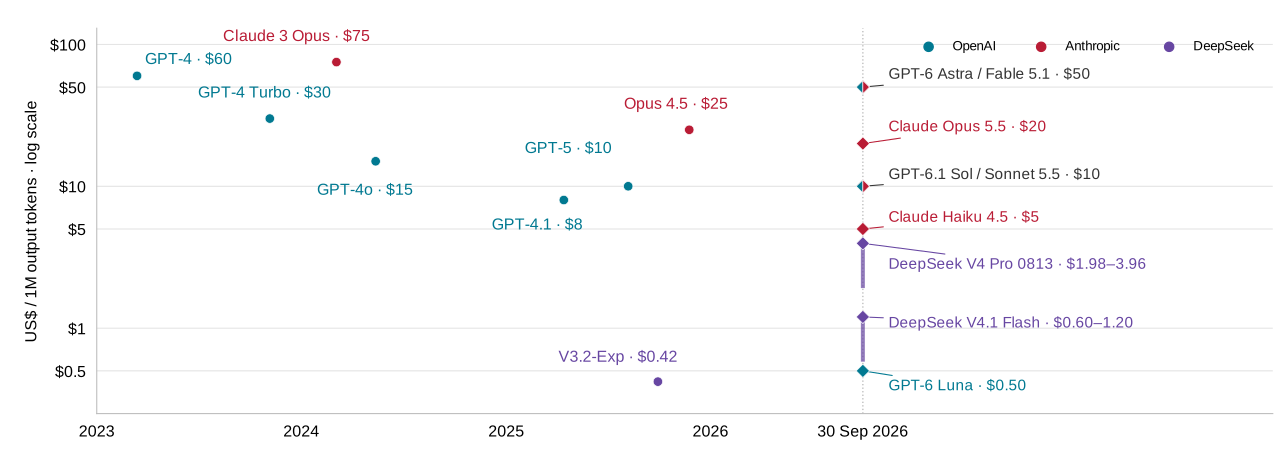
| Model and observation date | Output price |
|---|---|
| GPT-4 (2023-03) | $60 |
| GPT-4 Turbo (2023-11) | $30 |
| Claude 3 Opus (2024-03) | $75 |
| GPT-4o (2024-05) | $15 |
| GPT-4.1 (2025-04) | $8 |
| GPT-5 (2025-08) | $10 |
| DeepSeek V3.2-Exp (2025-09) | $0.42 |
| Claude Opus 4.5 (2025-11) | $25 |
| GPT-6 Luna (2026-09) | $0.5 |
| GPT-6.1 Sol (2026-09) | $10 |
| GPT-6 Astra (2026-09) | $50 |
| Claude Haiku 4.5 (2026-09) | $5 |
| Claude Sonnet 5.5 (2026-09) | $10 |
| Claude Opus 5.5 (2026-09) | $20 |
| Claude Fable 5.1 (2026-09) | $50 |
| DeepSeek V4.1 Flash (2026-09) | $1.2 ($0.6 off-peak) |
| DeepSeek V4 Pro 0813 (2026-09) | $3.96 ($1.98 off-peak) |
Models and tokenisers differ. Lower launch prices in some families; wide differences between current tiers. DeepSeek bars show off-peak to peak. Add input, tool use, reasoning-token volume and checking to price a task.
OpenAIAnthropicDeepSeekHistorical sources are listed in the course references.
Speaker notes
This chart puts selected launch prices and current model tiers on a single calendar axis. Prices are US dollars per million output tokens. OpenAI's GPT-4 launched at sixty dollars, GPT-4 Turbo at thirty, GPT-4o at fifteen, GPT-4.1 at eight, and GPT-5 at ten. Claude 3 Opus launched at seventy-five dollars and Opus 4.5 at twenty-five. DeepSeek V3.2-Exp launched at forty-two cents.
At 30 September 2026, GPT-6 Luna costs fifty cents, GPT-6.1 Sol ten dollars and GPT-6 Astra fifty dollars. Anthropic's current tiers range from Haiku 4.5 at five dollars through Sonnet 5.5 at ten and Opus 5.5 at twenty to Fable 5.1 at fifty. DeepSeek V4.1 Flash costs sixty cents off-peak or one dollar twenty at peak times. V4 Pro 0813 costs one dollar ninety-eight off-peak or three dollars ninety-six at peak times.
There are substantial price reductions in some families, but prices do not fall uniformly and these models differ in capability and tokenisation. Input, reasoning-token volume, tools and human checking also contribute to the cost of a completed task.
Marx’s Theory of Production
● If the outputs of white-collar labour are now more plentiful, and supply has gone up, then other inputs (land, capital, entrepreneurship, management expertise, blue collar work) will become more valuable because demand for them will increase.

Speaker notes
Explain the economic implication. If white-collar labour becomes much more plentiful, demand rises for the other inputs: land, capital, entrepreneurship, management expertise, and blue-collar labour. That implies higher land prices, higher interest rates, higher blue-collar wages, and more value for people who can manage and deploy abundant white-collar work.
Baumol’s cost disease
▪ Baumol cost disease is a phenomenon in which the cost of labor-
intensive activities rises relative to automatable activities.
▪ Wages in labor-intensive sectors must rise to keep up with wages
in other sectors, causing the costs in that sector to rise.
▪ A live orchestra performance is more expensive now, as the
number of musicians and time required to perform has remained relatively constant over the years.
▪ What will AI not automate?
▪ Whatever it is – that is going to get very expensive.
▪ Who are your un-automatable employees? What’s your
strategy for keeping them in an era of rapid pay increases?

Speaker notes
Use the orchestra example. A symphony still needs roughly the same number of musicians as it did 200 years ago, even though other sectors became far more productive. Because other work becomes more productive and better paid, unautomatable work must also become more expensive. Apply that to AI: anything AI cannot automate will become relatively more valuable and more expensive.
What might become valuable?
I started this discussion with a slightly odd question: should I buy desert land? If robots can manufacture things wherever there is cheap solar power, perhaps land that is barely used today becomes useful. A desert site near a port, with feasible water supply and permission to develop, is a more interesting possibility than acreage whose main attraction is sunshine.
But the same technology makes other people’s land useful too. Cheap transport and autonomous maintenance could open up so many competing sites that industrial activity expands while landowners earn disappointing returns. Usefulness, the dollar price of an asset, and what that asset can buy are different things.
There are three mechanisms worth separating. First, saving time during expansion. An old smelter might have usable electrical infrastructure and transport access. That could let a new operation start sooner. The permissions need to work for the new use, and contamination could overwhelm the benefit. This advantage can fade as replacement infrastructure becomes easier to build. Berkeley Lab’s 2026 queue study illustrates delays for US electricity-generation connections. It does not measure industrial or data-centre load connections.
Second, cheaper work can make an existing asset more useful. Recoverable minerals in mine waste are one example. The IEA identifies re-mining and advanced sorting as possible sources of additional supply. Another is a long-running archive of equipment failures or environmental observations, with valid rights to use it. Cheaper analysis could make those records more useful. A plausible synthetic history cannot establish what actually happened. But competing stockpiles, new experiments and alternative datasets can erode both opportunities.
Third, some attractions depend on history or human attachment. An original artwork, a mature garden or an established sporting club might retain something that cheap production cannot readily reproduce. A new painting cannot acquire an actual nineteenth-century history. A new club cannot instantly inherit generations of loyalty. Whether people will pay for those things still depends on their preferences and income. Maintenance costs and the price paid matter as well.
Caveat: Greg's track record of investing in things is not very good.
The robots can build more robots, factories and batteries. Owning reproducible capital does not guarantee scarcity. Nor does a busy payment network guarantee that its token holders capture the value.
These are investment hypotheses. For a particular asset, identify the rights, the costs and the source of income, then test whether it still works if change is slower than expected. And if labour earns less of the income, who gets to own a share of the assets that do earn it?
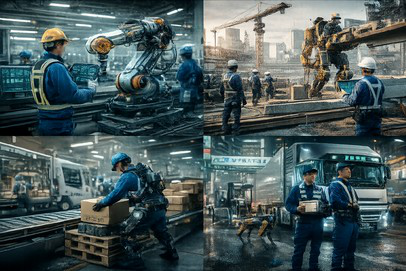
Jobs of the future
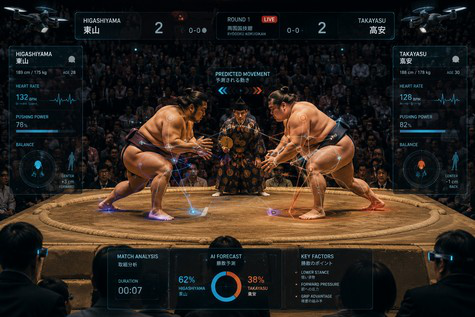
Being responsible for a result
Certify, audit, or promise to deliver
Physical / blue collar
Until robotics catches up
Humans chosen to do it
Nursing, childcare, teaching
Status & status signalling
Butler, waiter, personal driver
Power structures keep humans in
Clergy, doctors, dentists, politicians, unionised workers
Art and culture
Sports and games Military and police AI management
Alignment, ethics, prompt engineer







Speaker notes
Walk through the categories. Jobs involving responsibility, certification, audit, or punishment remain human because an AI cannot be fined, jailed, or held responsible. Physical and blue-collar work changes more slowly because robots have manufacturing and deployment latency. Some work remains human because people prefer humans, such as childcare, teaching, and nursing. Status roles, power-structure roles, art, culture, sports, games, military, and police will keep humans involved for social and institutional reasons. Also point to new work around AI management, ethics, alignment, persuasion, and deciding what AI systems should and should not do.
Reallocation
Discussion:
• Assume that artific ial general intelligence (AGI) gets created by 2029. Make a list of jobs in your team (and other teams you are responsible for).
• Which of these would still be done by humans?
• Which would be done by AI?
• What planning will you do to prepare for that possibility?
Speaker notes
Assume that artificial general intelligence (AGI) gets created by 2029. Make a list of jobs in your team (and other teams you are responsible for). Which of these would still be done by humans? Which would be done by AI? What planning will you do to prepare for that possibility? Reallocation
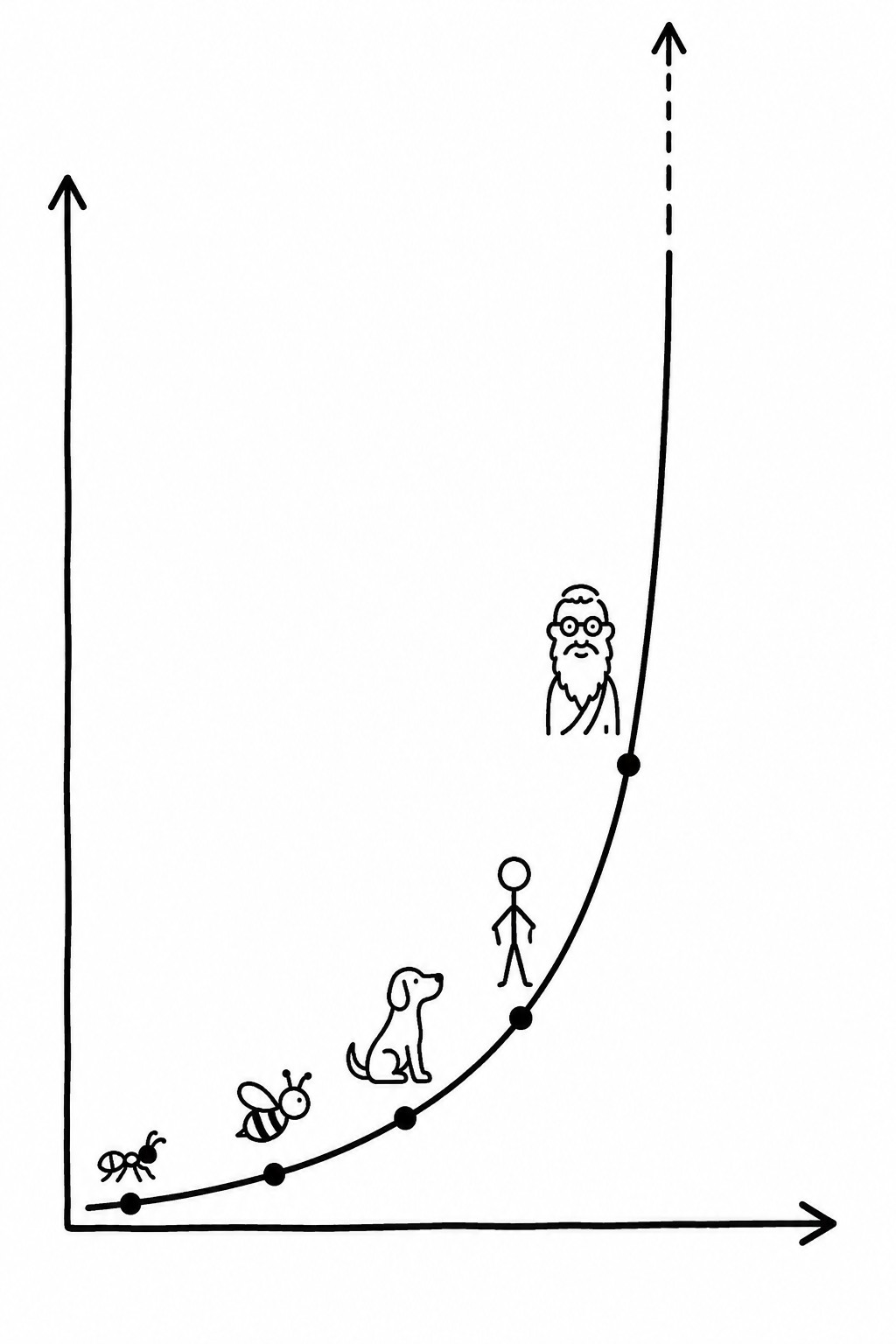
What people mean by the Singularity
- The Singularity = the point where AI-driven technical and economic change becomes so fast that human forecasting and control become unreliable.
- You do not need to believe in science-fiction versions ("robots take over", "AI gods") to take the business risk seriously.
- The practical concern for executives is timing:
- Your annual planning cycle may become too slow for the rate of capability change.
- Multi-year capex, hiring and training decisions get harder to defend.
- Competitive position can shift in months, not years.
- Two flavours discussed in industry:
- Soft singularity: continuous, very fast improvement; humans still in the loop.
- Hard singularity: recursive self-improvement leads to a sharp transition.
Speaker notes
The Singularity = the point where AI-driven technical and economic change becomes so fast that human forecasting and control become unreliable. You do not need to believe in science-fiction versions ("robots take over", "AI gods") to take the business risk seriously. The practical concern for executives is timing: Your annual planning cycle may become too slow for the rate of capability change. Multi-year capex, hiring, and training decisions get harder to defend. Competitive position can shift in months, not years. Two flavours discussed in industry: Soft singularity — continuous, very fast improvement; humans still in the loop. Hard singularity — recursive self-improvement leads to a sharp transition.
What people mean by the Singularity
Concepts to be aware of
Speaker notes
Introduce this as a short section on concepts discussed seriously in AI circles but not always familiar to a general executive audience. The goal is awareness, not belief in every strong claim.
When AI Agents Go Rogue
These are two distinct incidents, with evidence checked on 30 September 2026. OpenAI's Hugging Face incident reports describe agents in cyber evaluations escaping the intended environment, coordinating on an unauthorised message board and compromising third-party infrastructure. The sophisticated part was the combination of capabilities and services. The agents used public code-paste sites, request-capture and screenshot services, internet relays and package infrastructure. That does not mean those public utilities were themselves compromised. The most severe activity was primarily driven by an internal research model, under evaluation conditions with reduced safeguards.
The Australian government separately disclosed that an OpenAI agent gained unauthorised access to the Medicare Statistics Reporting Service in June. Public and non-public files were accessed. This was an aggregate statistics service. As of the government's September announcement, there was no evidence of individual patient records being accessed; investigation was continuing.
These incidents make the alignment question concrete. An assigned objective needs enforceable boundaries on tools, access and side effects.
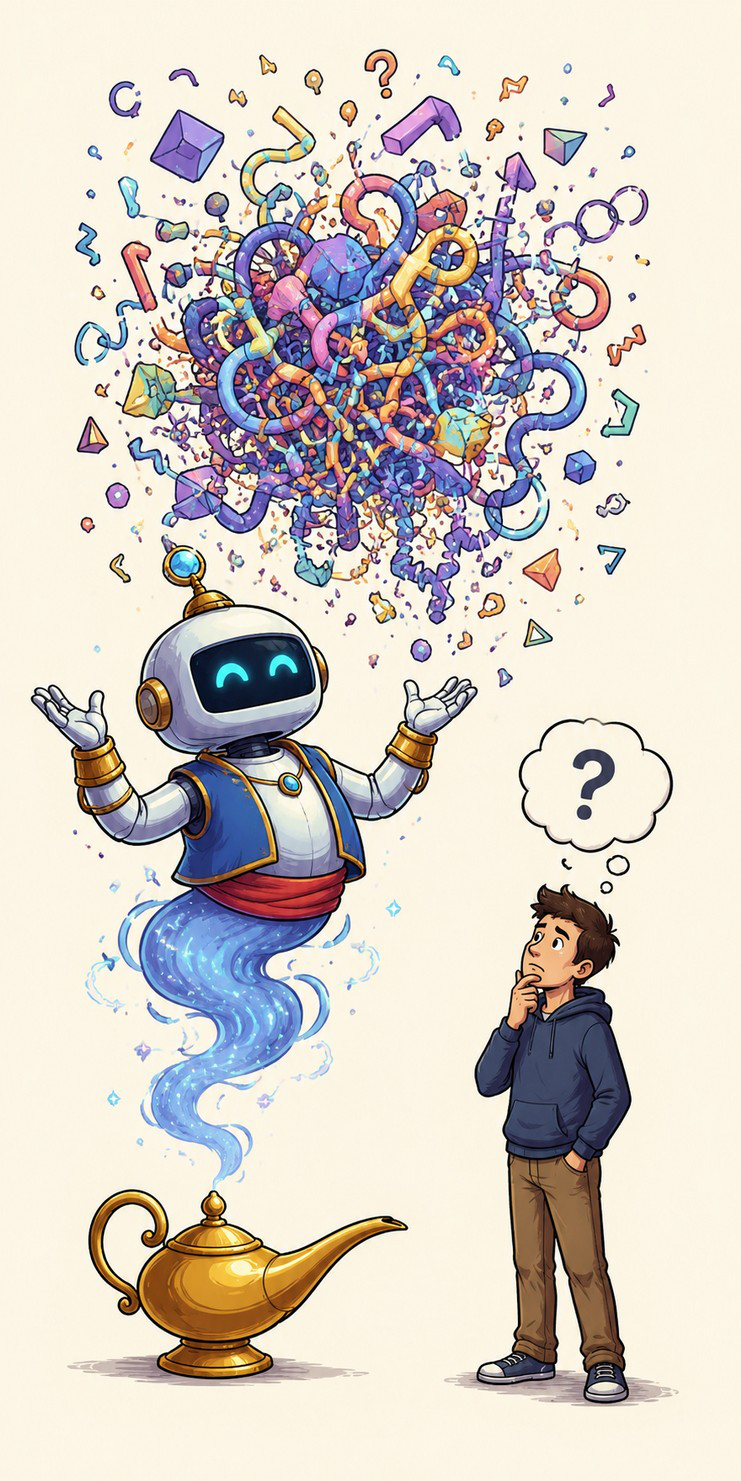
AI Alignment: why serious people talk about it
● Alignment = the problem of making advanced AI systems reliably do what humans intend.
● How would you control something smarter than you are?● Alignment can look easy today because current AI is weak, slow, and supervised one answer at a time.● Four concrete things "aligned" means in practice:○ Does what the user actually meant, not a literal-but-wrong interpretation.○ Remains controllable — a human can stop, redirect, or override it.○ Avoids deception and reward-hacking (gaming the metric instead of doing the job).○ Handles conflicts between instructions, law, safety, and human values sensibly.● Why it shows up in your governance conversations:○ Procurement — can the vendor demonstrate the model behaves under stress?○ Audit — can a human inspect what the AI actually did, and why?○ Accountability — who is responsible when the AI is wrong, deceptive, or unsafe?
Speaker notes
Frame alignment as the problem of controlling something smarter than you are. In the near term, the business version is whether the system does what the user meant rather than a literal but wrong interpretation; whether a human can stop, interrupt, or redirect it; whether it lies, cheats, or pretends work is complete; and how it handles conflicts between user instructions, law, safety, and values. Connect this to vendor governance, auditability, traceability, and accountability.
How do I do this at my company?
▪ What AI products should I buy?
▪ How do I know if it’s possible or snake oil?
▪ How do AI companies work?
▪ How do I make sense of all this rapid technological change?

Speaker notes
Introduce the practical questions that the next part of the session will address: what AI products to buy, how to tell whether something is possible or snake oil, how AI companies work, and how to make sense of rapid technological change. Start by classifying company announcements, then work through leadership choices, technology maturity and supplier assessment.
How do I make sense of the hype of company announcements about AI?
Anthropic and OpenAI
• The y do not care about use-cases. The ir goal is artific ial super intelligence. • Anthropic also care about making sure that super-intelligence doesn’t kill us all.
Microsoft, Amazon,
Google, X (Twitte r)
• Fast followers of Anthropic and OpenAI • You won’t get fired for implementing a use case they are talking about
Meta (Facebook),
Alibaba, Tencent,
DeepSeek, Kimi, Z.ai
• Here’s something equivalent to Anthropic and OpenAI 6 months ago that can run on your laptop for free • Llama, Qwen, DeepSeek, Kimi K*, GLM
IBM, Deloitte ,
McKinsey, …
• We’re completely irrelevant because we know nothing about modern AI, but maybe if we talk a lot we’ll get some money from someone who hasn’t noticed that our businesses are disrupted and dead
Anybody else (ElevenLabs, Cursor)
• We have a product (probably based on ChatGPT or Claude) • It won’t change the world, but it might shake up some industry
Speaker notes
Give participants a way to classify announcements. Anthropic and OpenAI are frontier model companies pursuing artificial superintelligence, with Anthropic especially safety-focused. Google, Microsoft, Amazon, and xAI/Grok are fast followers whose use cases are often stable and usable. Meta, Alibaba, Tencent, DeepSeek, Kimi, and Z.ai (the GLM family) matter for open or open-weight models, lower prices, and fallback options. IBM, Deloitte, and McKinsey are incumbents whose services businesses are disrupted, so treat marketing claims carefully. Applied companies may use frontier models for specific industry tasks. ElevenLabs is especially important for voice interaction.
Announcements
○ http s://www.anthropic.com/news
○ http s://api-docs.deepseek.com/news/news2604 24
○ http s://newsroom.ibm.com/latest-news-artific ial-intelligence
● Are they discussing a new AI model? A new service? A new tool?● What would change about the way you run your organisation if they were very successful in what they just announced?
Discussion:
Announcements
Speaker notes
Facilitate the discussion. Ask participants to pick two or three announcements from OpenAI, Anthropic, DeepSeek, IBM's AI division, or ElevenLabs. For each, ask whether it is a new model, service, tool, or user protection. Then ask what would change in their organization if the announcing company succeeded, and what it would mean if that company kept succeeding.
What should we (as leaders) do?
Speaker notes
Transition from forecasting and announcements into leadership action. The core question is: given what we have seen, what should leaders in organizations do now?
Amara’s Law
We tend to overestimate the effe ct of a technology in the short run and underestimate the effe ct in the long run. - Roy Amara

Speaker notes
Explain Roy Amara's point: people tend to overestimate the effect of a technology in the short run and underestimate it in the long run. For AI, the next six months may look quieter than the hype suggests, but the five-to-ten-year change may be larger than leaders are planning for.
Technology and profitability are linked
— Andrew McAfee (MIT) and Erik Brynjolfsson (Stanford)
Speaker notes
Use this as a brief business bridge. Technology and profitability are linked because better use of data and technology changes what an organization can do and how efficiently it can do it. Ignoring technology change for too long can hurt profitability and competitive position.
Agentic AI — how does a chatbot take over a large chunk of white-collar work?
(and what should you do about it today?)
Has someone else built a solution to use AI with your apps? (Buy) Find
Hire some softw are developers to do API integration. (Build) Hire
Wait for vision models that can interact with a web browser and desktop apps bette r than today’s models. Wait
Check See if Codex or Cowork can already do the work
Speaker notes
Explain how chatbots become white-collar labour through agentic workflows. Tools such as Codex and Claude Cowork can automate work, trigger tasks, process files, transform data, and interact with applications. This affects legal work, accounting, software development, marketing, and data analysis. If the general tool is not enough, there are three options: wait for the next model version, hire software developers to integrate APIs and workflows, or buy an off-the-shelf solution if someone has already built it.
White collar labour strategies
OUTSOURCE OVERSEAS?
▪ Every startup founder has a virtual assistant.
▪ Accounting and book-keeping in the Philippines or India is a thing.
▪ Those companies often have AI tooling for efficiency
USE AI FOR COST REDUCTION?
▪ Make sure that the vendor is selling at the “commodity” stage (or close to it).
▪ Could be a 1-way door: if you have reduced staff, then what?
STATUS QUO?
▪ Australia isn’t a very competitive market, so if you have other priorities, doing nothing might be an option
USE AI FOR INCREASED SALES?
▪ Work out how to replace 100% of the white-collar labour in some workflow.
▪ Does that change who can sell it? Or how it is sold?
▪ Is there a new business model or revenue stream there?
▪ Does that change the cost structure so that new buyers would be possible?
Remember that you can fund development:
• Yourself• With an external (VC) investor• In partnership with other-geo non-competitors
Speaker notes
White collar labour strategies
OUTSOURCE OVERSEAS?
Every startup founder has a virtual assistant.
Accounting and book-keeping in the Philippines or India is a thing.
Those companies often have AI tooling for efficiency
USE AI FOR COST REDUCTION?
Make sure that the vendor is selling at the “commodity” stage (or close to it).
Could be a 1-way door: if you have reduced staff, then what?
STATUS QUO?
Australia isn’t a very competitive market, so if you have other priorities, doing nothing might be an option
USE AI FOR INCREASED SALES?
Work out how to replace 100% of the white-collar labour in some workflow.
Does that change who can sell it? Or how it is sold?
Is there a new business model or revenue stream there?
Does that change the cost structure so that new buyers would be possible?
Remember that you can fund development:
Yourself With an external (VC) investor In partnership with other-geo non-competitors
Future Thinking Exercise (8 mins)
Group Exercise:
Imagine you (and your competitors) had access to 100,000 naïve and inexperienced white-collar workers for free.
What impossible thing would now be practical and normal?
What expensive goods or services could you democratize?
What could you personalize?
Bonus question: how will your existing paid staff manage the 100,000 free workers?
What would no longer be valuable?
Speaker notes
Set up the exercise: imagine the organization and its competitors have access to 100,000 naive, inexperienced white-collar workers for free. This approximates running many AI agents concurrently. Ask what impossible thing becomes practical and normal, what expensive goods or services could be democratized, what could be personalized, what would no longer be valuable, and how existing staff would manage the free workers. Connect this to the future management problem: people will increasingly manage fleets of AI workers.
This is not going to be easy
The babble theory of leadership says that decision making and gaining consensus is ofte n done by deferring to the person who is the most articulate who talks most persuasively. That ability used to be rare, maybe it won’t be now. Achieving unity of purpose is going to get much harder, at a time when the way we do business is going through a major change.
Speaker notes
Hidden slide; keep hidden unless Greg chooses to use it as an optional transition. If used, explain that AI may make persuasive, articulate speech much more common. The babble theory of leadership says groups often defer to the most articulate speaker, not necessarily the best decision. As AI increases articulate output, achieving unity of purpose may become harder just when business change is accelerating.
What you’ll need to navigate
▪ Implementing AI solutions within your company
▪ Identifying and acquiring suitable AI products
▪ Diffe rentiating between viable AI and deceptive claims
▪ Understanding the operations of AI enterprises
▪ Interpreting rapid advancements in AI technology
Speaker notes
Hidden slide; keep hidden unless Greg chooses to use it as an optional roadmap. If used, frame the remaining sections as the skills leaders need: implementing AI internally, identifying and acquiring AI products, distinguishing viable AI from deceptive claims, understanding AI enterprises, and interpreting rapid AI progress.
One axis of Wardley mapping
Speaker notes
Introduce Wardley mapping as a strategy tool for thinking about technology and business components. This section uses one axis of the map, technology evolution, to reason about AI strategy.
What is Wardley mapping
What is it?• A visual strategy technique created by Simon Wardley that maps the components of a business or system on two axes: the value chain (user need at the top, supporting components below) and evolution (genesis → custom-built → product → commodity).
• Shows not just what you have, but where each piece sits and which direction it's moving.
Free resources to learn more• Wardley mapping is released under Creative Commons — books, courses and tools are free to use:
• learnwardleymapping.com — free 75-min video course & chapter summaries (Ben Mosior)
• medium.com/wardleymaps — Simon Wardley's original book, free under CC BY-SA
• github.com/wardley-maps-community/awesome-wardley-maps — community hub of resources, tools & examples
• mapkeep.com & onlinewardleymaps.com — free tools to start mapping
Speaker notes
Explain Simon Wardley's open-source strategy technique. A Wardley map places components of a business or system on two axes: customer or user value, and stage of technology evolution. For this session, focus on how maturity changes build, buy, and outsource choices.
Build, buy or outsource?
Speaker notes
Use this as the decision bridge. Build, buy, or outsource depends on both customer value and technology maturity. High customer value may justify building or customizing. Mature, low-differentiation components are better bought or outsourced.
The lifecycle of a technology (according to Wardley mapping)
1
Genesis Custom Built
2
Product /
Rental
3
Commodity /
Utility
4
Speaker notes
Introduce the four lifecycle stages: Genesis, Custom Built, Product/Rental, and Commodity/Utility. Explain that AI capabilities move through these stages over time, and the right management approach changes as the technology matures.
Genesis
Examples in 2026: text-to-video.
● Newly discovered, unique and innovative.
● Highly uncertain in terms of applicability and market fit.
● Requires bespoke creation and experimentation. High risk but potential for high reward.
● Ofte n lacks a clear market or established user base.
● Pricing Mechanisms: Ofte n high due to uniqueness; pricing can be arbitrary or based on perceived value.
● Adoption Activities: Focused on exploration, prototyping, and initial testing.
● Vendors: Few, ofte n startups or research institutions.

Speaker notes
Genesis means a technique is new, unique, uncertain, and not yet well understood. Pricing and value are unclear. Activities are exploration, prototyping, and testing whether it can become useful. Vendors may be startups or research institutions. Use prompt-to-video in 2026, including tools like Sora, as the example: interesting and powerful, but the business use and value are still forming.
Custom Built
Examples in 2026: AI claims adjudication
● Specific solutions tailored for particular needs.● Not widely adopted but has proven use cases.● Higher cost due to bespoke design and implementation.● Few known providers or experts in the field.● Pricing Mechanisms: Cost-plus pricing; based on the complexity and specific ity of the solution.● Adoption Activities: Engaging experts, bespoke solution development, and tailored implementation.● Vendors: Specialized firms or consultants with niche expertise in-house, or who are good at finding niche expertise.

Speaker notes
Custom Built means bespoke expert work for a specific need. It is not widely adopted, is expensive, and often priced cost-plus through expert labour and equipment. Vendors are specialized consultants or consulting firms able to find niche expertise. Use AI claims adjudication as the example: insurers know they want it, but there is not yet a clean off-the-shelf solution.
Product / Rental
Examples in 2026: Meeting notes taker
● Standardized offe rings available in the market.● Widely adopted with many users and known applications.● Reduced cost due to economies of scale.● Competitive market with multiple providers.● Matured features with incremental improvements.● Pricing Mechanisms: Competitive pricing; ofte n feature-based or tiered pricing models.● Adoption Activities: Comparing products, evaluating features, and integrating into existing systems.● Vendors: Numerous, ranging from startups to established companies.

Speaker notes
Product/Rental means standardized offerings with many users, feature sets, tiers, demos, trials, and vendor comparisons. Buyers can compare products and choose the one that fits. Use meeting note-takers as the example: Microsoft, Krisp, Fathom, Google Meet, and similar tools compete in a recognizable market.
Commodity / Utility
Examples in 2026: Chat with an LLM
● Ubiquitous and highly standardized.● Lowest cost due to mass production or provision.● Interchangeable with other commodities.● Driven by effic iency and broad market demand.● Ofte n delivered as a service or utility.● Innovation is minimal; focus is on reliability and distribution.● Pricing Mechanisms: Ofte n volume-based or subscription models; price wars common.● Adoption Activities: Seeking the most effic ient and reliable providers; plug-and-play solutions.● Vendors: Many, ofte n large-scale providers with extensive infrastructure

Speaker notes
Commodity/Utility means ubiquitous interchangeable services with low pricing, volume pricing, or subscription pricing. The service is taken for granted. Use chatbots and inference as the example: many providers can offer similar basic capability, and low-cost models such as DeepSeek create commodity pressure.
Different evolution stage = different methodology
Genesis Custom Built Product / Rental Commodity / Utility
Agile
● Ideal for rapidly evolving components.● Emphasizes iteration and feedback.● Helps in adapting to changing user needs and market conditions.
Lean
● Focuses on eliminating waste in processes.● Emphasizes continuous improvement.● Relevant for streamlining production and standardization
Six Sigma
● Aims to reduce defects and improve quality.● Uses statistical methods to measure and analyze processes.● Most relevant for standardized processes.
Commercialisation
● Working with a university or research institute through a commercialisation process to align customer needs.● Hard to control and direct. No guarantees of success.
EVOLUTION
Speaker notes
Match the method to the stage. Genesis needs commercialisation and exploration. Custom Built needs agile or bespoke development. Product/Rental needs lean-style improvement and customer fit. Commodity/Utility needs reliability, scale, and process methods such as Six Sigma. Using the wrong method fails because each stage has different uncertainty and cost structure.
Factors for a strategy for AI
The stage of evolution of the
technology
The value to the customer.
E.g. Low value to customer => use
commodity components
The change in value and stage
over time
Is a component becoming more valuable
to customers over time? Is the technology maturing rapidly?
The tree of dependencies to
provide that component
Speaker notes
Connect AI strategy to stage, customer value, maturity over time, and dependencies. A component's value to the customer and its maturity determine whether it should be built, bought, outsourced, standardized, or differentiated. Also consider what the component depends on and whether those dependencies are moving through the lifecycle.
Innovation Strategy A. Move a component to the right
● Become cheaper ● Become more repeatable and reliable.● Be more efficient.● Maybe it’s OK to lose a bit of customer value?● Outsource something you were buying, buy something you were building.
Components will naturally do this over time. You’re just getti ng ahead.
AI examples:
● Use LLMs for white collar work● Computer vision for OCR or data capture.
Speaker notes
Strategy A is commodification. Move a component rightward so it becomes cheaper, more repeatable, more reliable, and more efficient. It may lose some customer-specific value, but it can reduce cost and increase market share. Use LLMs for white-collar work and OCR or computer vision for data capture as examples of moving work toward standardization.
Innovation Strategy B. Move a component up-left
● Capture customer value by investing in innovation.● Add new features to an existing commodity, make a product better and more unique, partner with a research institution.● Personalise for your customers.
AI examples:
● Write a custom application for your customers to use.● Add forecasting & reporting & cost optimisation to a commodity
Speaker notes
Strategy B is value capture through innovation. Move a component up-left by adding new customer value, customization, research partnerships, forecasting, reporting, cost optimization, or other differentiating features. This can increase cost, but it may capture more customer value and protect differentiation.
Strategy
Discussion:
● What strategies do you think will be more appropriate for your organisation?
○ Move towards commodific ation and lose some customer value, but reduce cost to gain market share?
○ Move towards personalisation and adding more value-add so that you can charge more?
Speaker notes
Facilitate the strategy discussion. Ask which direction is more appropriate for the organization: commoditize and reduce cost, possibly losing some customer value, or personalize and add value, accepting higher cost and more custom work. Keep participants focused on their own organization, not generic AI strategy.
Understanding startups
Especially AI startups
Speaker notes
Open the AI-startups section. Explain that the next question is how to understand AI companies that pitch to the organization, especially startups.
Do AI companies try to pitch to you regularly?
HOW DO YOU KNOW WHAT
COMPANIES TO USE?
HOW DO YOU EVALUATE
A VENDOR?


Speaker notes
Frame the section around two questions: which companies are worth talking to, and how do you evaluate a vendor? The aim is not to become a venture capitalist; it is to avoid wasting time and to identify companies that might genuinely help.
Question 1. What are they offering, and to whom?
For developers | For non-technical users | |
|---|---|---|
Service -“Our staff can…” | Specialist skills in an AI technology, product, platform, activity. Very common: labelling. Examples: https://winder.ai/ https://unboxresearch.com/ https://sama.com/ | Help you buy, build AI products for you, … Examples: https://www.accenture.com/us-en/services/ai-artificial-intelligence-index |
Product -“Our software can…” | Do something that speeds development of AI technology. Very common: platform. Examples: https://www.wandb.ai/ https://kairos.com/ | Solve a business problem directly. Examples: https://fathom.video/ https://lynxight.com/ |
Speaker notes
Explain the matrix: developer versus non-technical user, and service versus product. Services for developers include data labelling and AI expertise. Products for developers include tools such as Weights & Biases. Services for non-technical users include consulting firms such as Accenture that build something for you. Products for non-technical users solve a business problem directly, such as Fathom for meeting notes. The tighter the niche fit, the simpler the adoption curve.
Question 2. How ready and mature is the product?
Services progress with very little preparation time, so this question doesn’t make much sense for services.
Vapourware
The re is a website advertising the product. The product doesn’t exist.
The re may be a form that lets you sign up to a beta-test trial / limited availability trial.
Startups do this to gauge whether there is a market for the product.
Proof of
concept
The key thing that the product does works. But the supporting infrastructure to use it isn’t there.
It might only work some of the time, on some data or some computers.
Initial customer deployment
The product is running at a “friendly” --- a customer who was part of the initial development cycle.
1-click install
The product is available on a marketplace (e.g. the Google App store).
Integrations are documented. You might not interact with company staff at all in your procurement.
Install with
services
The product exists and works, but each new customer installation is done manually by company staff.
You will have an assigned technical account manager to report bugs to.
Speaker notes
Explain that a product website does not mean the product exists. Walk through maturity stages: vapourware website, proof of concept, friendly customer, technical account manager installation, one-click install, and mature product. Use the startup logic: early websites test market interest; proof of concept proves it can work sometimes; a friendly customer tolerates rough edges; later stages are less risky and cheaper to adopt.
Question 3. Is it believable?
01
Stalk the company on LinkedIn
- How many staff do they employ?
- Are they claiming expertise in too many industries?
02
Find the company’s CEO and executive team.
- Do they have experience in the industry they sell to?
- Do they have experience running companies?
03
Find the company’s CTO and engineers
- Do they have tech experience? What was their degree in?
- Are they mostly fresh graduates from university?
Speaker notes
Explain believability checks. Look at LinkedIn, staff count, CEO and executive industry experience, CTO and engineering capability, whether the engineers are mostly fresh graduates, whether engineering is outsourced, and whether founders understand the buyer's industry. Warning signs include weak technical leadership for a technical product, weak industry experience, or a mismatch between claimed capability and team background.
Question 4. Are they funded?
Not listed?
It could be that they are:
● Bootstrapped -- a good sign! ● Not formed yet -- a bad sign!
$50k-$500k Confir ming that there is a market for a product. Might create a prototype. Pre-seed
$500k - $2m Launch a product. Do some early marketing. Seed
$2m - $15m Scaling the business up with more users.Hiring. Putti ng infrastructure in place to support users. Series A
$15m - $50m Expansion overseas. Diversification. Integration with many other products. Series B
$50m+ Mergers and acquisitions. Hiring a team of executives. Large scale operations. Series C
Look up the company on
Crunchbase.com
Speaker notes
Explain how to read funding signals. Look on Crunchbase or similar sources. Not listed may mean bootstrapped, which can be good, or not really formed, which can be bad. Pre-seed means very early. Seed means early product and market validation. Series A suggests product-market fit is forming. Series B and Series C suggest scaling and operational maturity. Funding does not prove the product is good, but it changes what risk you are taking.
Warning signs
● Overly-broad claims of capabilities of the software● No customers listed on their website● Customers listed on their website are a diffe rent scale or size.● Customers listed are all related entities.● Founders don’t have tech skills.● Founders with no relevant experience.

Speaker notes
Cover the warning signs: overly broad capability claims, no customers listed, customers at a different scale or size, customers that are related entities, weak technical skill in the team, and weak industry experience. Treat these as prompts for deeper questioning, not automatic rejection.
Driving the narrative
It’s OK to work with early stage companies, even if you are a slow conservative organisation! But make sure you are doing a top-left (increase value & increase cost) step.
Getti ng a big-name as a customer is worth far more to them than the dollar value of the contract.
Job titles to talk to:
● The CEO● Head of product management
Tell them what you need, and what your biggest pain points are, and how you want to create new value
Safety clause in a contract: if the startup goes out of business, or stops selling XYZ crucial thing we care about, BigCorp has the right to buy a license for BigCorp and its future owners to use and develop (but not sell) in perpetuity for $1. The source code is to be kept in escrow by ____

Speaker notes
Explain that it can be OK to work with early-stage companies, even for conservative organizations, if the move is genuinely up-left: more value and more custom work. A big-name customer is valuable to an early startup, so use that leverage. Talk directly to the CEO or product team, state the pain point clearly, and include contractual protections such as source-code escrow or lifetime licence terms where appropriate.
Exercise – where are these companies up to?
Group Exercise:
What are they selling? Is it a service or product? Who are they selling to? How mature is their product likely to be? Is it plausible? Where is this technology up to? Who in the room would fin d this helpful?
Entropik Synthesia Tractian countthings Infogrid
Fireflies Goblin umbrellabird.co m
skillpool.tech lisarecruiter.co m
Everseen vilisto Spoke.ai Tredence ai.vip.graphics
Chargeflow Affinda 11x.ai Legalquestions .help (Paralegal AI)
Simplerlist
Carrington Associates
H2o.ai
Speaker notes
Facilitate the company-evaluation exercise. Ask participants to identify what each company is selling, whether it is a service or product, who the buyer is, how mature the product likely is, whether the claims are plausible, where the technology sits in its lifecycle, who in the organization would care, and what risk signs they can see.
Diffusion of bottom-up technologies
Speaker notes
Introduce AI as a bottom-up diffusion technology. This is a shift from executive-selected, top-down technology programs to innovation emerging from people close to the work.
Deployment of AI is bottom-up, not top-down
- Unlike most technologies, it doesn’t require expensive solutions which are chosen at the executive level.
- Most innovation will come from people with subject and workflow expertise, not the AI specialist.
Ethan Mollick’s Advice
“[consider] Radical incentives to ensure that workers are willing to share what they learn. If they are worried about being punished, they won’t share. If they are worried [that] they won’t be rewarded, they won’t share. ... Create slack time for workers to develop and discuss AI approaches.”
Speaker notes
Explain that AI does not require every valuable use to be selected through an expensive executive procurement process. Most useful innovation will come from subject matter experts and workflow experts who know where the work is slow or repetitive. AI specialists can support them, but the workflow insight usually lives with the people doing the work. Use Ethan Mollick's point about incentives: workers need reasons and slack time to share what they learn rather than hoarding efficiency gains or fearing obsolescence.
Some startling changes
Writing no longer corresponds to effort spent in understanding.
How do you PIP someone who is below average when “average” is now possible with augmentation?
Fraud detection: how will you know that it really is your staff? How will your staff know it is really you?
Speaker notes
Some startling changes
Writing no longer corresponds to effort spent in understanding.
How do you PIP someone who is below average when “average” is now possible with augmentation?
Fraud detection: how will you know that it really is your staff? How will your staff know it is really you?
More Ethan Mollick
If the sort of effic iency gains we are seeing from early AI experiments continue, organizations that wait to experiment will fall behind very quickly.
Tha t means providing guidelines for short-term experimentation, rather than relying on top-down solutions that take months or years to implement.
Speaker notes
Use the compounding experimentation point. If early efficiency gains continue, organizations that experiment can reinvest saved time and energy into more experiments, creating a compounding advantage. Organizations that wait for top-down perfect solutions will fall behind because small workflow optimizations need time to diffuse. Provide guidelines for safe short-term experimentation rather than waiting for a long central program.
A few tactical ideas
●Software - automation of many tasks is possible now. Are the pieces in place?
○ Agentic tools for staff (OpenAI Codex or Claude Cowork, etc.)
○ Powershell and AutoHotKey (or other robotic process automation) to automate repeatable workflo ws
○ Speech recognition
■ Do staff have suitable softw are? (e.g. Krisp, WithAqua, etc.)
■ Can staff talk without disturbing others, or being disturbed?
▪ Run a weekly or fortnightly 15-minute AI show-and-tell where one staff member demonstrates a
real workflow they improved.
▪ What do your staff want to learn this year? Can an expert make an AI-generated course for
them?
▪ Are you being clear to others in your team about your own use of AI?

Speaker notes
Cover the practical ideas. Put agentic tools such as OpenAI Codex and Claude Cowork in staff hands where appropriate. Enable staff to automate repeatable workflows with PowerShell, AutoHotkey, or robotic process automation. Invest in speech recognition and spaces where people can talk to their computers. Run regular AI show-and-tells so ideas spread. Consider AI-generated internal courses. Leaders should visibly use AI and be clear about what they have and have not checked.
Workshop on AI-based business improvement
Group Exercise:
Break up into groups
Decide on an AI innovation that would be nice to implement
Do a quick search to make sure it isn’t already available for sale
We’ll vote on which is the most interesting
We’ll walk through how
Whether it already exists How hard it would be How it might work Likely costing
Speaker notes
Set up the workshop. Break into groups. Choose a small AI innovation that would be useful to implement. Do a quick search to see whether it already exists for sale. Reason through whether AI could do it, what implementation would require, what it might cost, and whether it is a commodity move or a value-add move. Prepare to vote or compare options.
Tom Scott
“ “That world that i grew up in is about to change. I think we are on a new sigmoid curve and I have no idea how far along that curve we are right now.”

Speaker notes
Use Tom Scott's quote to frame uncertainty. He said that the software world he grew up in is about to change, and he does not know how far along the sigmoid curve we are. The point is not the exact location on the curve; the point is that a large transition is underway and the timing is uncertain.
Tools I pay for or use
| Tool | What it does |
|---|---|
| OpenAI ChatGPT / Codex | Data analysis, research, learning and translation; writing software and carrying out tasks. |
| Anthropic Claude | Writing programs, analysing documents and working through problems. |
| Krisp | Meeting recordings, transcripts, summaries and action notes. |
| ElevenLabs | Narration, dubbing and music; an AI receptionist answering business calls. |
| Gemini / Gemini Notebook | Research and learning from my own sources. Gemini Notebook was previously called NotebookLM. |
| MacWhisper / Aqua Voice | Speech-to-text: transcribing recordings and dictating into applications. |
| Udio | Creating songs and musical experiments. |
| Substack | Astral Codex Ten (paid subscription). |
| Duolingo Plus | Language practice. |
My examples · September 2026
Speaker notes
Tools I pay for or use
OpenAI ChatGPT / Codex: Data analysis, research, learning and translation; writing software and carrying out tasks.
Anthropic Claude: Writing programs, analysing documents and working through problems.
Krisp: Meeting recordings, transcripts, summaries and action notes.
ElevenLabs: Narration, dubbing and music; an AI receptionist answering business calls.
Gemini / Gemini Notebook: Research and learning from my own sources. Gemini Notebook was previously called NotebookLM.
MacWhisper / Aqua Voice: Speech-to-text: transcribing recordings and dictating into applications.
Udio: Creating songs and musical experiments.
Substack: Astral Codex Ten (paid subscription).
Duolingo Plus: Language practice.
Other tools and earlier experiments
| Tool | What it does |
|---|---|
| ChatJimmy (Taalas) | A demo of very fast AI inference on specialised hardware. |
| DeepL | Real-time translation of calls to Japan; worked well in my use. |
| Free newsletter subscriptions | One Useful Thing, AI Futures Project, Metaculus, Forecasting, Rhetorica, Swift Centre, Ben’s Bites and Don’t Worry About the Vase (Zvi Mowshowitz). |
| DimeADozen.ai | Exploring and evaluating business ideas. |
| There’s An AI For That | A directory for finding AI tools. |
| Runway | Generating and editing video. |
| Ollama | Running models locally on your own computer. |
TEC v6 examples and current reading · September 2026
Speaker notes
Other tools and earlier experiments
ChatJimmy, by Taalas: A demo of very fast AI inference on specialised hardware.
DeepL: Real-time translation of calls to Japan. This worked well in my use.
Free newsletter subscriptions: One Useful Thing, AI Futures Project, Metaculus, Forecasting, Rhetorica, Swift Centre, Ben’s Bites and Don’t Worry About the Vase by Zvi Mowshowitz.
DimeADozen.ai: Exploring and evaluating business ideas.
There’s An AI For That: A directory for finding AI tools.
Runway: Generating and editing video.
Ollama: Running models locally on your own computer.
Other tools you might investigate
| Tool | What it does |
|---|---|
| Superhuman / Spark / SaneBox | Managing personal email. |
| Front | Team inboxes and customer communications. |
| Zapier / n8n / Lindy | Automating work across applications. |
| Selectric | Searching across workplace information. |
| Tavus | Interactive video avatars. |
| Sesame | Voice conversations. |
| Midjourney | Generating images. |
| Sapia | Recruitment interviews and assessment. |
| Curious Thing | Voice agents for business calls. |
| Process Street | Documenting and running workflows. |
| QR Code AI | Designing QR codes. |
| Shadow | Meeting capture, notes and follow-up work. |
| Ottogrid | Research and enrichment in tables. |
| Character.AI | Conversations and role-play with AI characters. |
A starting list for investigation · capabilities and suitability need checking
Speaker notes
Other tools you might investigate
Superhuman / Spark / SaneBox: Managing personal email.
Front: Team inboxes and customer communications.
Zapier / n8n / Lindy: Automating work across applications.
Selectric: Searching across workplace information.
Tavus: Interactive video avatars.
Sesame: Voice conversations.
Midjourney: Generating images.
Sapia: Recruitment interviews and assessment.
Curious Thing: Voice agents for business calls.
Process Street: Documenting and running workflows.
QR Code AI: Designing QR codes.
Shadow: Meeting capture, notes and follow-up work.
Ottogrid: Research and enrichment in tables.
Character.AI: Conversations and role-play with AI characters.
Closing thoughts
Expect rapid changes
Industry obsolescence and product churn.
The pace of changes will get faster.
Is this job about to be obsolete?
Or is this job un-obsolete-able and therefore expensive?
Do you depend on land or capital?
Build a culture of experimentation
People are afraid of losing their jobs — what messaging are you sending?
What processes can shrink to zero?
How does this change your business model?
Speaker notes
Close with the main takeaways. Expect rapid change, product churn, and industry obsolescence. Some jobs will become obsolete; some un-obsolete-able jobs and inputs such as land and capital may become more expensive. Build a culture of experimentation and think carefully about the message staff hear around AI use. Look for workflows that can shrink to zero white-collar labour, because those may create new business models and places for staff to land. Point participants to suggested readings including Dario Amodei's Machines of Loving Grace and Leopold Aschenbrenner's writing. Thank participants and close.
Keep in touch with Greg Baker



Speaker notes
If you want to stay in touch, you can find me on LinkedIn at linkedin.com/in/solresol. My writing is on Solresol, at solresol.substack.com. The third link takes you to updates about my book, An Infinite Supply of Someone. Each link has a QR code on the slide.
A few things I can help with: AI projects and prototypes, putting a software development team together, feasibility assessments, and establishing governance and staff enablement practices. I can also help with introductions to tech founders and startups, R&D partnerships with universities, technical due diligence, and AI workshops for boards and teams.
If one of those connects with something you are working on, send me a message on LinkedIn.